How to Increase Your Home's Value Before Selling
By the HousingPortal.ca team · Updated June 2026
The smartest sellers do not renovate their home before listing — they invest selectively. The goal is to spend one dollar and recover two or more at the closing table. That means focusing on improvements that align with what buyers in your specific market are already expecting, rather than personal preferences or ambitious renovation projects that will never earn back their cost. The difference between a strategic pre-sale investment and an over-improvement can easily be $20,000 to $50,000 in net proceeds. This guide walks through the highest-return moves, what to avoid, and how to use your agent and a pre-listing inspection to make those decisions with confidence.
The Principle Behind Value-Add Improvements
Not all money spent on a home comes back at sale. Some improvements — routine maintenance, for example — simply prevent value from eroding. Others genuinely add dollars to what buyers will pay. The investments worth making before a sale are those that either remove an objection buyers would otherwise use to negotiate down the price, or create a perception of quality that justifies a higher asking price. The calculation is not just what you spend but what the alternative costs you: a buyer who sees a dated kitchen may offer $30,000 less, while a $12,000 update that modernizes the space more than recovers that gap.
Maintenance vs. Improvement
Before thinking about upgrades, address deferred maintenance. A buyer who sees a stained ceiling, a cracked driveway, or a furnace that is clearly past its service life will not give you credit for the money you spent on granite countertops — they will instead focus on what else might be wrong. Maintenance protects your asking price; improvements build on top of it. Fix the leaking faucet, replace the rotted fascia board, and repair the crumbling grout before you consider a single aesthetic upgrade. A home that is in excellent repair throughout sells faster and with fewer price concessions than a renovated home with obvious deferred maintenance.
The Highest-ROI Improvements in Canada
Based on recurring data from Canadian real estate professionals and appraisers, these are the improvements most likely to return their cost and then some at resale.
Improvement | Typical Cost (CAD) | Estimated ROI |
|---|---|---|
| Minor kitchen update | $5,000–$15,000 | 75–100%+ |
| Bathroom refresh | $3,000–$10,000 | 70–90% |
| Fresh neutral paint | $2,000–$5,000 | 100–150% |
| Curb appeal / landscaping | $1,500–$6,000 | 100%+ |
| New lighting fixtures | $500–$2,000 | 90–120% |
| Front door replacement | $1,000–$3,500 | 80–100% |
| Deep clean + declutter | $300–$1,000 | 100%+ |
Paint is the single highest-return investment available to a seller. A fresh coat of warm white or warm greige throughout — including trim, doors, and ceilings — photographs beautifully, makes rooms feel larger and lighter, and signals to buyers that the home has been cared for. Choose a neutral that works in both natural and artificial light.
Kitchen Updates That Actually Pay Off
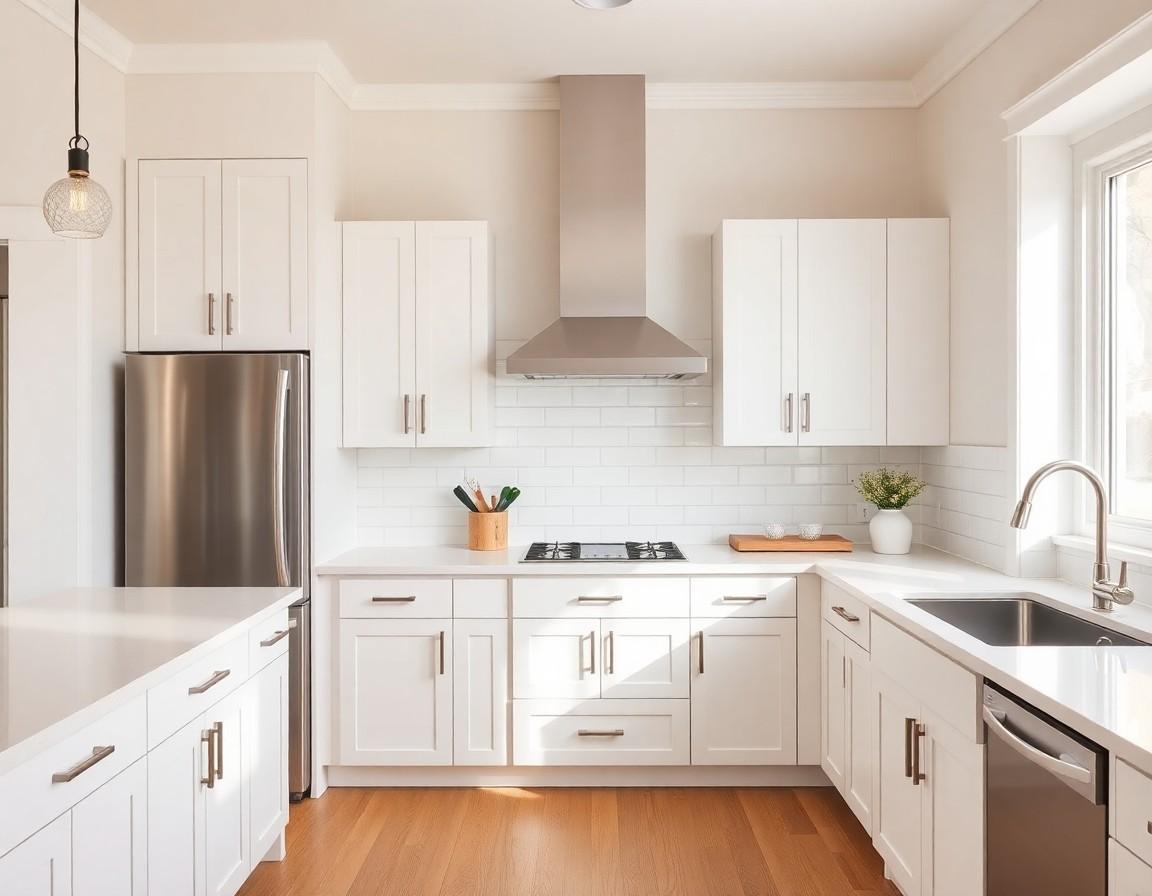
A full kitchen renovation — new cabinets, new layout, relocated plumbing — rarely pays back in full at resale. What does pay off is a targeted refresh that makes an existing kitchen look current without structural changes. Replacing cabinet hardware with brushed nickel or matte black pulls is a $300 project that transforms a dated kitchen. Painting or refacing cabinets costs a fraction of replacement and dramatically updates the look. A new faucet, updated light fixture, and fresh caulk around the sink complete the picture. If countertops are badly worn, replacing them with quartz (not marble — too high-maintenance for a listing) can tip buyers in your favour. The test is simple: does the kitchen look like a photograph from a current design magazine? If yes, stop spending.
Bathroom Refresh on a Budget
Like kitchens, bathrooms can be modernized without full renovation. Re-grouting tile, replacing a vanity light, installing a new mirror, and adding a fresh vanity can turn an old bathroom into a selling point for under $2,000. If the toilet or toilet seat is visibly old, replace it — buyers notice. If the shower or tub has mould or heavy staining that cleaning cannot fix, address it before listing. The goal is a bathroom that feels clean, bright, and neutral — not one that reflects the last owner's personal taste.
Curb Appeal: The First Impression That Sets the Tone
Buyers form a strong opinion of a home before they step through the door. A tidy, well-maintained exterior signals that the interior is likely the same. Mow and edge the lawn, remove dead plants, add fresh mulch to garden beds, and power wash the driveway and front walkway. If the front door is faded or chipped, repainting it in a bold-but-tasteful colour — a deep navy, forest green, or classic black — adds personality without alienating buyers. For listings happening in shoulder seasons in colder Canadian climates, potted evergreens flanking the entry point are a reliable year-round option. Curb appeal improvements also photograph well, and your listing photos are your first showing for most buyers in today's market.
Minor Fixes With Outsized Impact
Small details accumulate into an overall impression. Buyers notice things sellers stop seeing after years of living in a space: sticky doors, broken light switch covers, a wobbly railing, loose cabinet hinges, a dripping faucet, burned-out bulbs. Walk your home as if you have never been inside before and make a list. These are typically afternoon projects, and the collective effect is a home that feels tight, maintained, and move-in ready — which reduces buyer hesitation and negotiating leverage.
Updating light fixtures is a particularly effective small investment. Brass and chrome fixtures from an earlier era read as dated to most buyers. Replacing them with modern matte black or brushed gold equivalents costs $50 to $300 per fixture and changes the feel of a room meaningfully.
What NOT to Spend On
Certain improvements almost never recoup their cost at resale in Canada. Swimming pools are the most common over-investment: they are expensive to install, expensive to maintain, and actively unwanted by many buyers who see them as liability and labour. Sunrooms and three-season rooms perform poorly in cold Canadian climates where they are unusable for six months of the year. Over-the-top custom finishes — hand-painted murals, extremely personalized colour schemes, commercial-grade appliances in a modest home — appeal to a narrow audience and can actively reduce buyer interest. The goal is to appeal to the widest possible pool of buyers, not to showcase personal taste.
Decluttering and Deep Cleaning
No staging trick compensates for a home that is cluttered or visibly dirty. Buyers struggle to visualize their own life in a home full of someone else's belongings. A rigorous declutter — remove roughly one-third of everything in every room — makes spaces look larger, allows buyers to focus on the home's architecture rather than its contents, and simplifies your own move. Rent a storage unit if necessary. Follow the declutter with a professional deep clean: carpets, grout lines, windows inside and out, appliances, light fixtures, and every surface. A professionally cleaned and decluttered home has almost certainly the highest return on time and money of any pre-listing activity.
The Pre-Listing Home Inspection
Paying for a home inspection before you list — rather than waiting for the buyer to order one — puts you in a far stronger position. It surfaces deficiencies you can address on your own timeline and budget, rather than scrambling to respond during a conditional sale or accepting a price reduction to compensate. It also allows you to present the report proactively to buyers, which signals transparency and reduces the likelihood of buyers using inspection results as a negotiating tool. In competitive markets, sellers who pre-inspect can offer buyers the option to waive their inspection condition, which makes their offer considerably more attractive.
Renovate vs. Price to Sell As-Is
Not every home benefits from pre-sale improvements. If the market in your area is extremely active, buyers may be competing regardless of condition, making renovations less necessary. If the home is on land that a developer might assemble, buyers may prefer a lower price and the opportunity to renovate to their own taste. Your agent is the right person to help you assess this: they have seen what comparable homes sold for in their current condition, and what renovated equivalents have achieved. The question is not what you can do — it is what the market in your specific neighbourhood will reward.
Working With Your Agent on a Pre-Sale Plan
An experienced listing agent has walked through dozens or hundreds of homes in your neighbourhood and knows precisely what buyers in your price range are expecting. Ask them directly: what are the two or three things that would add the most to the sale price in my specific situation? Their answer will be market-specific in a way no general guide can replicate. Some agents also have relationships with tradespeople who can execute small improvements efficiently before listing. The agent's goal is the same as yours: the highest possible sale price, since their commission depends on it.
Questions to Ask Before You List
Before committing to any pre-sale improvement, press your agent and yourself with a few concrete questions. What did comparable homes that needed work sell for versus those in move-in condition? What is the dollar gap, and does the improvement you are considering close it at a profit? How long will the improvement take, and does that timeline fit your listing plans? Is there a risk that the improvement will not appeal to the specific buyer demographic your home is likely to attract? These questions prevent the common mistake of investing emotionally in improvements that feel right but do not pencil out financially.
Start Here
The most effective first move before any other improvement is to walk your home with a notepad and photograph every issue you would notice if you were seeing it for the first time. Address deferred maintenance first, then declutter and deep clean. From there, your agent can help you rank the remaining opportunities by expected return in your specific market — and the ROI table above gives you a useful starting framework for that conversation.
Related guides & tools
The information presented on HousingPortal.ca is intended for general illustrative purposes only. While the information is believed to be reliable, it cannot be guaranteed for accuracy, completeness, or currency. Neither HousingPortal.ca and its employees, nor any other party identified in this guide/report, assumes any liability for the information provided. The views and opinions expressed by the analysts at HousingPortal.ca are their own and should not be considered as investment advice. It is recommended that you seek the advice of a licensed real estate professional before making any decisions regarding real estate investments.